View details
Men's Health
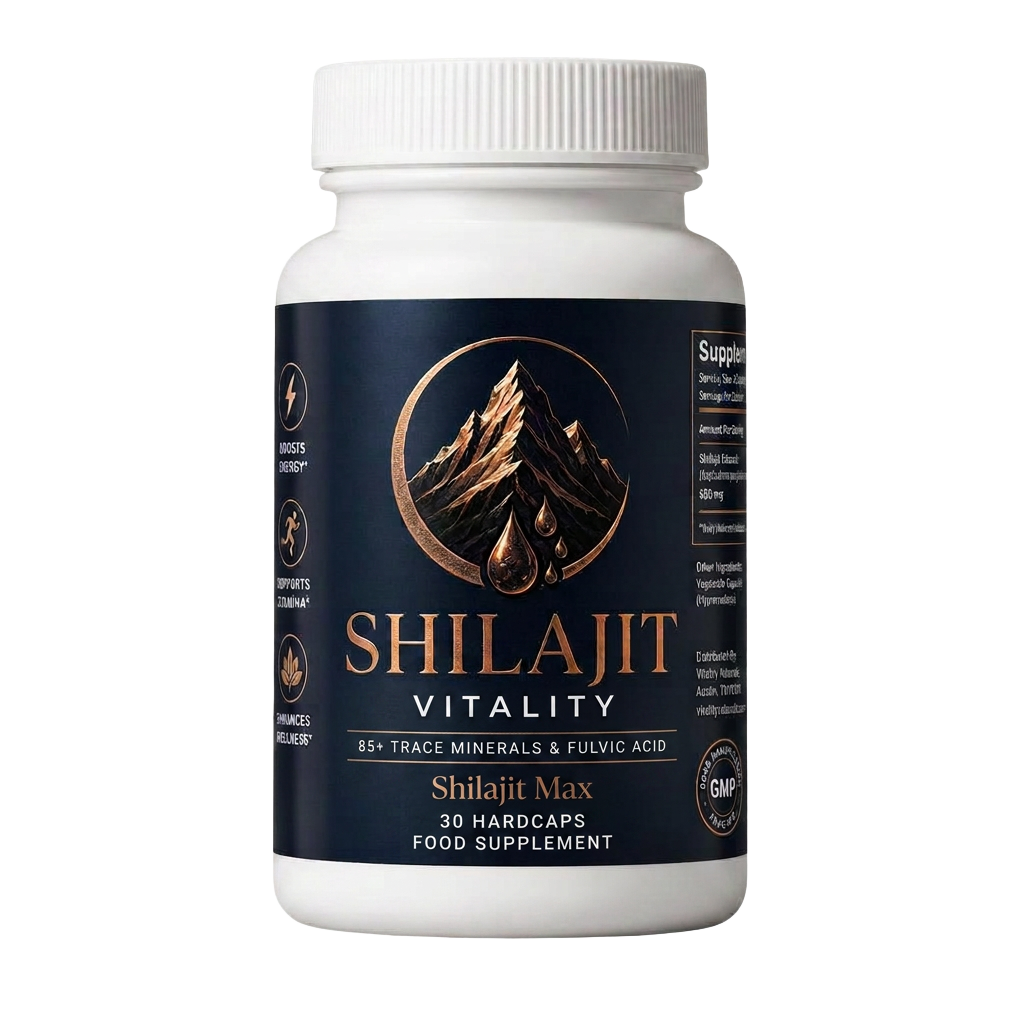
Shilajit Vitality
Best for daily wellness
85+ Trace Minerals & Fulvic Acid · 30 Hardcaps
Pregnancy
18+
Med
€34.00
Free EU delivery
Save 16%
From €28.22/bottle
Mineral
Shilajit is a resinous exudate collected from rock crevices in high-altitude regions, principally the Himalaya and Altai. It is a complex, geologically formed material rather than a single compound; fulvic and humic substances plus trace minerals make up the bulk of its analysed content.
Shilajit is included in our formulas as a botanical ingredient with traditional wellness heritage. No authorised health claim has been approved for it under EU or GB law, so we share only its identity, origin, dose and documented history — never implied benefits.
Claims held “on hold” pending evaluation are treated here as unauthorised. We will not imply an effect through images, testimonials or suggestive wording either.
Wording we never use for Shilajit
supports · improves · boosts · reduces · treats · prevents · balances · detoxes · protects
Forms
Sold as purified resin or as a dried extract standardised to fulvic acid content. Because it is mined, heavy-metal testing on every batch is the single most important quality control, and purified material should always be preferred to raw.
Sourcing
Rock exudate from the Himalayan mountains.
In our formulas
The cornerstone of Shilajit Vitality.
Can be taken daily; many prefer to take it in the morning for sustained energy.
Exact amounts per daily portion are declared on every product label and on each product page.
History
Shilajit is documented in Ayurvedic and Central Asian traditional systems. That documentation is historical, not evidential.
Recorded as history. A record of traditional use is not evidence of an effect and is not a health claim.
Evidence
Published human research is limited, with small trials on fatigue, testosterone and altitude tolerance, mostly using one supplier's purified extract. The evidence base is not sufficient for any authorised health claim in the EU or GB.
Safety
Buy only heavy-metal tested, purified material. Not for use in pregnancy or breastfeeding, or by children. Avoid if you have haemochromatosis or gout; seek advice if you take any regular medication.
Food supplements are not a substitute for a varied, balanced diet and a healthy lifestyle. Do not exceed the recommended daily portion. Keep out of reach of young children.
Featured in
Best for daily wellness
85+ Trace Minerals & Fulvic Acid · 30 Hardcaps
€34.00
Free EU delivery
From €28.22/bottle
Deep dive
Also in minerals